The work, as the questions I asked in order
- Test whether pricing format was the open lane. Known: most competitors already price as a flat share of gross. The question was what the category already does as standard, so the real point of difference could be found one layer beneath the format. It produced the comparison on the cover and ruled out "flat, not itemized" as a position. It pointed the design at what rides on top of the percentage.
- Name the trust gap precisely. Known: owners cannot observe daily manager behavior. "Trust" is too broad to design a fee around, so the question was which specific things a manager can do that an owner has no way to check. The answer was a short list: billing for services never fully rendered, marking up contractor invoices in transit, logging a maintenance call as handled when it was deferred. The design target became a fee that removes the unauditable items, not a marketing claim about trustworthiness.
- Choose flat, no add-ons, no markup, and set it below the local band. Known: a flat share aligns the manager's revenue with the owner's on the top line. The question was whether removing add-ons and markups closes the gap from step 2 or only its most visible slice. It closed the billing side completely, since an owner can now never be charged a hidden spread, and gave the company the lower headline rate as well. It did nothing about cost-side behavior.
- Name the risk the fix created. Known: the flat fee removes the add-on incentive. The question was what the manager's new incentive is at the margin, now that service cost comes out of a fixed number instead of being billed separately. The answer was the mirror-image risk above, and it turned the rest of the work from pricing into control design.
- Draw the threshold. Known: the cost-side risk needed a structural answer, not a promise. The question was where to draw the line between what the fee absorbs and what passes through, so that small deferred maintenance is visibly costly to the manager while large repair decisions stay out of the manager's hands entirely. It produced the maintenance-cost threshold with owner sign-off required above it. The dollar value of the threshold is set with each owner at onboarding, which is one of the six questions in Attachment A.
- Build the signal that catches what the threshold cannot. Known: a threshold and a sign-off rule reduce the risk; they do not detect it happening. The question was the earliest available signal of a service failure. A review is voluntary and lags the stay by days; a guest message during the stay is neither. Logging both, by category, is what catches the problem most guests never write a review about.
- Find what compounds. Known: the fee structure is copyable by any competitor in an afternoon. The question was what a property entering this portfolio gets that a brand-new manager's first client does not. The answer was the categorized guest-issue history across every unit already under management. A new property starts closer to the portfolio's operating standard instead of the manager learning that owner's guests from zero, and the advantage widens with every unit, which the fee never will.
The one-sentence test, as I run it
Say the offer out loud to someone who has never heard it, then ask them to say it back. If what comes back has a line missing, a tier they got wrong, or a "plus" they added, the offer failed, and the fix is to cut the line, not to explain it better. Then write down where the complexity you just cut went, and who is carrying it now. The offer is finished when both answers are on the page.
What it produced
The company launched on the model and runs on it. The rating on its listings has held inside the band Airbnb reserves for its best hosts, which is the floor a service-quality problem would show up by breaching. I read that as the downside protected rather than the upside proven, because a rating in this band mostly says the listing stayed visible and bookable, and nightly rate and occupancy are shaped as much by season and local supply as by the manager.
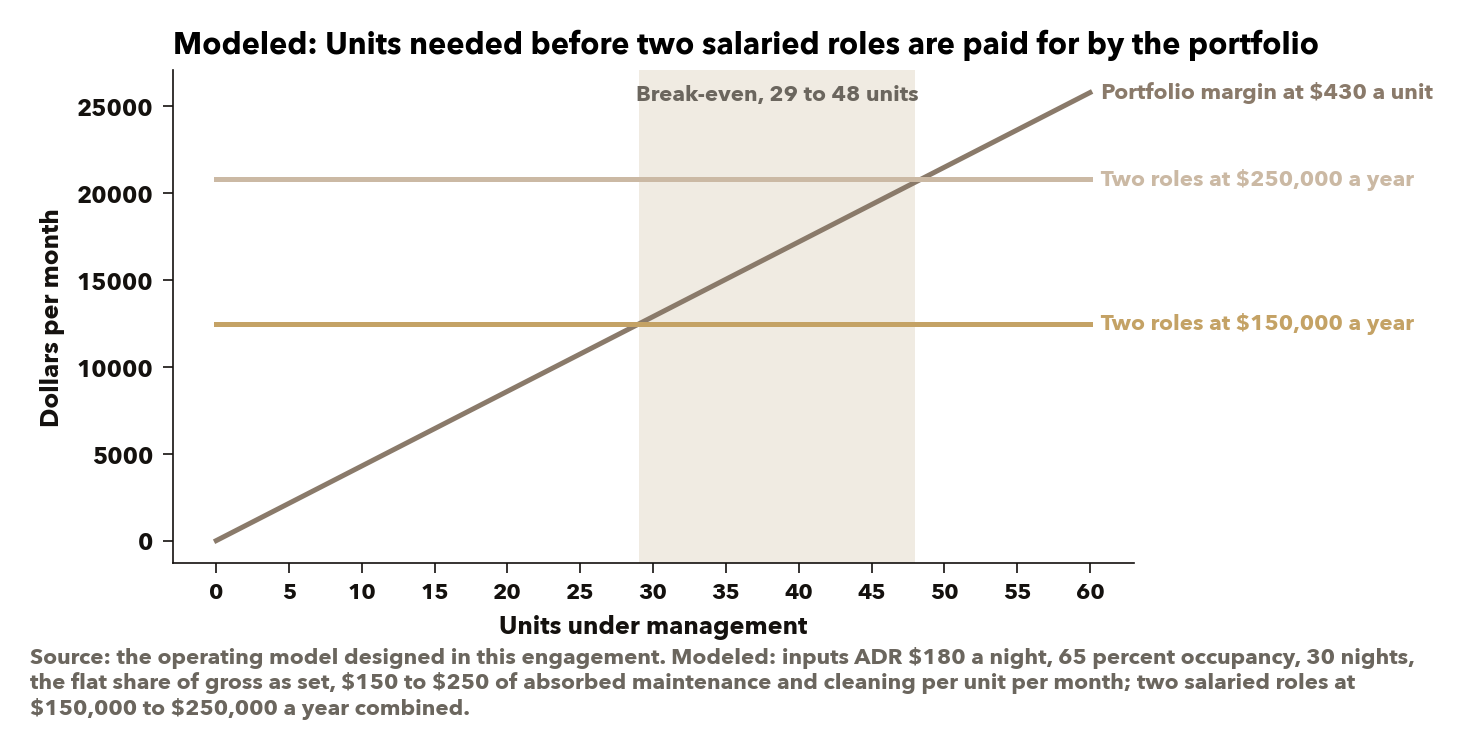
The figure that matters more is the one nobody in the category puts in front of an owner: what the fee has to carry before the operation the model describes exists as salaried people rather than as hats the operator wears. The chart below is modeled. Its inputs are illustrative, chosen to show the method and not to report this portfolio's books, and they are printed under the chart so the arithmetic can be checked. The shape is the point. At a flat share of gross, the margin left per unit after the absorbed cost stack is a few hundred dollars a month, and two salaried roles, an operations lead and a guest-experience seat, cost what two salaried roles cost. Summed margin has to clear that line before the roles are real, and the crossing sits at a few dozen units. Below it, the controls in this report are the operator's own discipline. Above it, they have owners.
The second thing it produced was the detection layer. Two signals feed it, and they are not the same thing.
| Signal | Review score | Guest-message log |
|---|---|---|
| When it arrives | After checkout, if the guest bothers | During the stay, at the moment of the problem |
| Who sends it | A minority of guests | Nearly every guest with a problem, because they want it fixed |
| What one entry moves | Almost nothing; one rating barely shifts a small portfolio's average | One dated line in the log, categorized, with a person responsible for closing it |
| What it can catch | A pattern, months late | A deferred repair before the next guest arrives |
| Who acts on it | Nobody, in time | The operations lead, escalating to the operator |
| Its job in this model | The scoreboard | The control |
The review score is the weaker signal. Most guests with a bad experience never write about it, and a review is both voluntary and late. At a small portfolio's review volume, one new rating barely moves the average, so a manager weighing whether to defer a small repair is not deterred by a signal that faint. The message log captures the complaint when it happens, whether or not it ever becomes a review, so the log, not the star rating, is the operative control on the cost-side incentive. The readings that show whether under-investment is happening are specific: mean days from a maintenance report to close, cleaning hours logged per turn, and the share of turns carrying a cleanliness flag. Attachment B is the log, with those three built into its monthly readout.
Everybody in the category charges a flat share, so the format was never the edge. The edge is a sentence an owner can believe, and then going to find the complexity that sentence just hid.
What we kept, what we replaced, what we installed
We kept the platform listings, the contractor bench and the operator's habit of handling guests personally. We replaced one thing, the category's fee sentence, and it deserves its own account. Nobody in particular put it in; it accumulated. A manager adds a cleaning coordination line because cleaners are a headache, a dispatch fee because maintenance calls come at night, a markup on the contractor's invoice because someone has to chase the contractor, and a tier that moves with occupancy because a flat number felt exposed in a slow month. Each line is defensible on its own. Together they price the owner's attention, not the work. A fee an owner needs three schedules to total is priced for how much friction the owner will absorb before shopping elsewhere. The logic was faulty in one specific place. It treated itemization as accountability, when an owner who cannot see the work cannot audit the items either, so every line that needed a phone call to explain quietly turned a checkable structure into a trust exercise. It had to change at launch because launch is the only moment an owner has not yet learned a different sentence. Rewriting the fee for an owner who signed under the old one is a renegotiation. Writing it right the first time is a sentence.
We installed four things: the one-sentence test on any offer before it reaches an owner; the maintenance-cost threshold with owner sign-off above it; the guest-message log kept alongside the review log, by category; and the onboarding question set that sets the threshold and locates inherited cost before a property joins. The roles the model is built around are below, as a RACI, with the honest note that until the portfolio clears the band in the chart above, the operations lead and the guest-experience seat are the operator wearing two more hats.
| Function | Does it | Answers for it | Asked first | Told |
|---|---|---|---|---|
| Pricing and rate strategy | Operations lead | Operator | Owner, on major changes | Owner |
| Guest communication | Guest-experience seat | Operations lead | Operator | |
| Cleaning and turnover | Cleaning contractor | Operations lead | ||
| Maintenance, below the threshold | Maintenance contractor | Operations lead | Owner | |
| Maintenance, above the threshold | Maintenance contractor | Operations lead | Owner, sign-off required | Owner |
| Review and message follow-up | Operations lead | Operator | Guest-experience seat | Owner |
| Owner reporting | Operator | Operator | Owner |
The rule the threshold runs on
Below the threshold, the manager fixes it out of the fee and logs it the same day, with the unit and the category. Above it, nothing is spent until the owner has seen the contractor's invoice and signed. The threshold is set with the owner at onboarding and belongs in the management agreement, not in anyone's memory, and it is reviewed when the owner asks or when a heavy month says it was set wrong.
What it cost to hold the line, and what I would watch
Holding the line cost the company the add-on and itemized revenue a competitor collects on top of a higher headline rate, given up by design. It costs a real margin hit every time a heavy maintenance month lands inside the fee instead of being passed through as it occurs. And it cost the cover that complexity provides. There is nowhere in this structure to hide a bad month behind a line item, which is the point of building it this way, but it means every shortfall shows up as margin taken directly rather than margin explained away. Handholding and giveaways, the calls an owner gets that a bigger manager would route to a portal and the small things done for guests with no line for them, are carried as cost on the operator's side every month. That is the deliberate, budgeted way this company buys the trust a simple fee cannot generate on its own.
It also cost me a cleaner story. The same instinct that strips a construction deliverable down to the slice a client can check was the right move on the fee, because a fee is one number. A management relationship is not one number. It runs every month, and the simplicity that makes the fee auditable does nothing on its own to show an owner absorbing a slow month of maintenance calls. Saying so plainly, and building the threshold and the log because of it, is less flattering than "flat fee, no add-ons, problem solved". It is also the only version that survives an owner's first bad quarter.
What I would watch, in a company like this one. Whether the threshold has been set with each owner and written down, because a threshold that lives in the operator's head is a deferral decision waiting to happen. Whether the message log is still being kept in a busy month, which is the month it matters. The three readouts in Attachment B, monthly, read by someone who knows what a rising days-to-close number means before the reviews do. The unit count against the band in the chart, because until the portfolio crosses it the controls have one owner, and that owner is also the person they are meant to check. And whether any owner ever leaves for a competitor's itemized model, and why, because that is the most direct evidence there is of whether a sentence beats a schedule.
The result, in short
The company launched on the model and runs on it. Its listings have held inside the band Airbnb reserves for Superhosts, whose published floor is a 4.8 rating, which reads as the downside protected rather than the upside proven. The controls installed, the one-sentence fee test, the maintenance threshold with owner sign-off, and the guest-message log kept alongside the review log, are still what the operator runs the business on. Below a few dozen units, the operations lead and guest-experience seat are hats the operator wears; above that band, they become salaried roles the portfolio pays for.
A slice of the project list
A few related projects.
- Village San Juan: property operations for a homeowners association (2015 to 2022)
- A PE-backed medical group: operating audit (2026)
- Modular housing fabrication center: operating model, Arizona (2026)
- Sublime Medical: fractional COO, a cosmetic medical group billing and coding fix (2015)